Showing posts with label pedestrians. Show all posts

Friday, February 24, 2023

Pendarvis Introduces Bill to Accelerate Transit Oriented Development in SC


I
Image left- Representative Marvin Pendarvis rising the #11 CARTA Bus stopped at the Charleston International
Airport. Since this image was taken a lighted shelter has replaced the basic outdoor bench at this stop.


North Charleston, SC-
 Legislation introduced Public Transit carefully fitted into SC communities which are allowed to leverage the mobility it offers to everyone will help create walkable, urbanized areas with lower crime, higher incomes, more rewarding civic and cultural life and less traffic congestion.

On Feb. 23, 2003, SC State Representative Marvin Pendarvis (D-CHS) introduced a bill H. 4013 in the SC House of Representatives to amend Title 6 of the S. C. Code by adding Chapter 39 regarding Transit-Oriented Development Projects. It has been Referred to House Committee on Ways and Means.

Image, Right, PlanningMap for N. Charleston Community improvement Meeting, 2018.

The district Pendarvis represents contains most of the separated busway section of the State’s first planned rapid transit system, the Lowcountry Rapid Transit System (LCRT) 
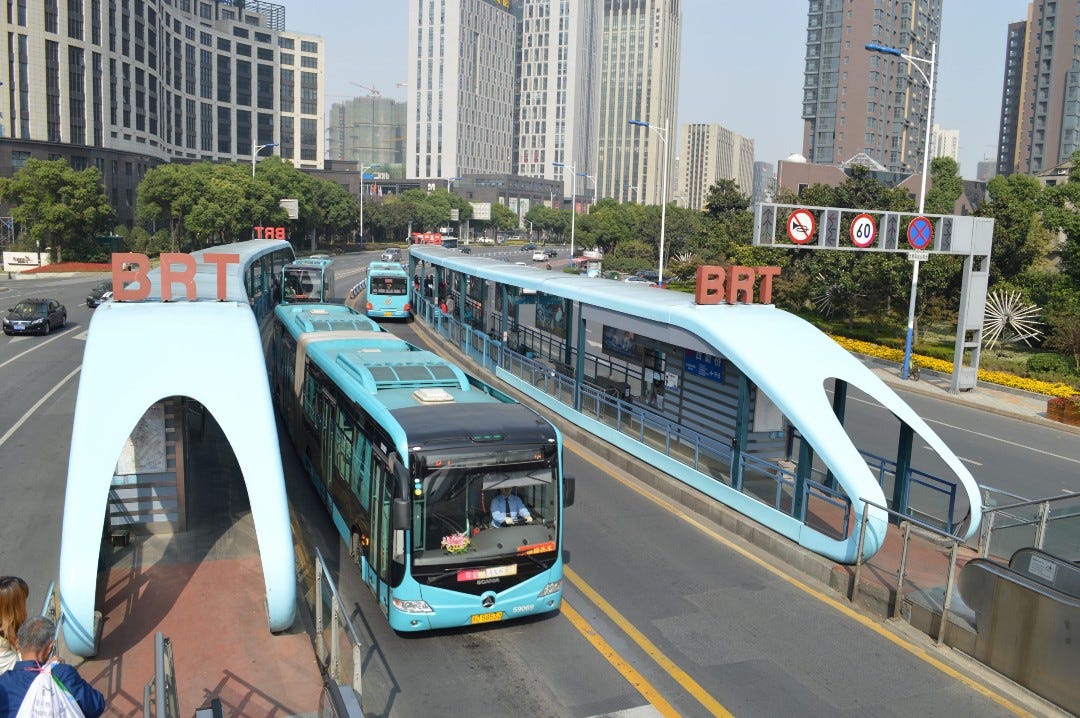
https://lowcountryrapidtransit.com/ online.  Charleston County voters approved funding for construction of the LCRT and other improvements to bus transit in November 2016. The LCRT is a Bus Rapid Transit system based on operation of articulated electric buses in dedicated bus only lanes, accelerated boarding and advanced electronic enabled wayfinding and fare payment.

The legislative findings set out in the bill begin by stating that, “Public Transit is a valuable element of providing mobility to the people of South Carolina and functions best in communities where density, walkable infrastructure, cycling and short distance transportation services can connect residents and workers efficiently between home, work, shopping, civic opportunities, recreation and education.” It goes on to note that transit benefits drivers by reducing congestion and making use of the existing roadways more efficient.

Children Planning Transit System on Large MapImage, Left, Children at N. Charleston Farmer's Market plannng model transit system for the Lowcountry on 12 x 16 foot map, October 2019

The bill notes that Transit benefits the disabled and other groups not often considered in making decisions about transportation planning, including “those who have lost their driver's license or lack insurance, reducing the number of illegal drivers on the road the costs of the collisions in which they are involved, which increases the cost of uninsured motorist insurance coverage.”


Unlike many bills introduced in the legislature which have been drafted by national special interest groups, this bill was drafted by Representative Pendarvis with the assistance of Lowcountry Transit riders, people who actually ride transit on a daily basis in his district. Research failed to find similar legislation in other states, so laws from other countries such as New Zealand and Canada were reviewed to help complete the proposed law. The law allows for establishing district and a district authority that can work with government and the private sector to build or redevelop neighborhoods, commercial properties and manufacturing facilities in areas where transit is or will be available.

Image, Right Jennifer  Saunders and the late Dave Crossley rampaging with Best Friends of Lowcountry Transit for passage of the half penny sales tax for Transit, Transportation and Greenspace during the Coastal Carolina Fair in October 2016.

The Berkeley Charleston Dorchester Council of Governments, The City of North Charleston, The City of Charleston and the Town of Lincolnville are already planning for improvements to the areas along the LCRT to create a safer, cleaner and more rewarding community where car ownership will not be a necessity. While this type of development can’t be constructed everywhere and may not be desired in other areas, its critical to the Elderly, Disabled, workers in Charleston’s critical hospitality Industry, Students and those otherwise unable or unwilling to drive to have some areas available in a region which are adapted to their needs.

Representative Pendarvis will now work with transit advocates, organizations working to build affordable housing and local governments to help the bill H. 4013 get the necessary committee hearings and votes in the house to cross over to the senate and ultimately be ratified by the Governor’s signature over the rest of the current two year legislative session. The LCRT is currently planned to begin rapid transit operation between the Fairgrounds in Ladson and MUSC in downtown Charleston in 2028.

Image, Left, Pizzeria Owner Ben D'Allesandro posting banner supporting improved transit in downtown Charleston, April 2017.

For more information on the Transit Oriented Development Bill see the full text at 
https://www.scstatehouse.gov/sess125_2023-2024/bills/4013.htm or see the Best Friends of Lowcountry Transit, Inc. at www.bfltransit.com online. Representative Pendarvis can be contacted through his legislative office at (803) 212-6716 or via https://www.scstatehouse.gov/member.php?code=1457812326 online. Pendarvis is planning community forums to discuss this and other issues related to improving the quality of life in his district and elsewhere in SC in the future.

Tuesday, March 22, 2022

Make Sure Transit in SC Gets it Share Update from DC on Federal Funding


We need to be sure that CARTA, LINK and the other little transit services in the area are asking for the funding that is available. Please review this and give us your input. 

At last week's CARTA Board meeting a staff member tried the old, tired, 

'We have no money" line on Millicent Middleton, who is trying to slow down the proliferation of white crosses on the Sea Islands where poor people trying to walk miles home, often after dark, get hit and killed by cars over and over. It's time to be sure that all of us, like Millicent, know and let them know that this isn't true. Over ten million dollars a year in local transit funding for the improvement of regular bus service is currently being misappropriated to road construction. The LCRT project is being delayed so it's funding can also be diverted to road construction. These agencies have millions in potential federal funding they can get as well. We still haven't gotten an answer from Nancy Mace on her position on our Transit Questions. We're going to be talking to all the Candidates for Congress from the 1st. and 6th. district and publishing what we're able to learn on Right to Ride Day, May 4. 


March 22, 2022

The Era of Bus Austerity is Over


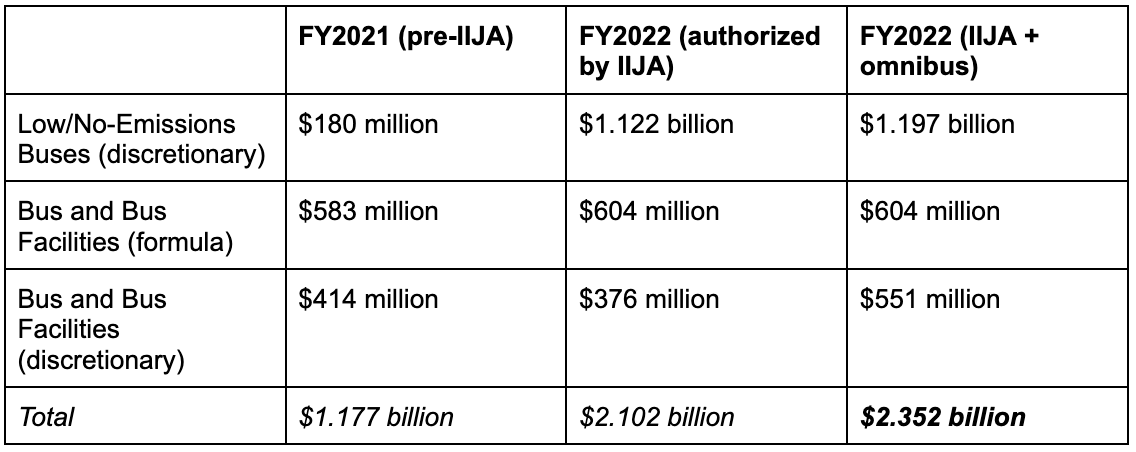
The Infrastructure Investment and Jobs Act–the “bipartisan infrastructure law” signed last year–offers limited relief when it comes to operating transit service. But the good news is that it represents a sea change when it comes to capital investment. It expands the size of the federal transit programs by at least 49%–not enough to meet all repair needs, but enough to allow many agencies to escape austerity and plan to improve the rider experience while modernizing what they have. 

A perfect illustration of this is the U.S. Department of Transportation’s most recent request for applications to the federal Bus and Bus Facilities Grant (USDOT calls this a Notice of Funding Opportunity, or NOFO). Earlier this month, USDOT issued a NOFO for two major grant programs that fund bus-related capital needs, with applications due May 31: 

  • $1.1 billion for the Low-No Emission Bus program, which pays for low-emission and zero-emission buses, facilities and equipment which supports them, and stations and stops that accommodate them.
  • $372 million for the Bus and Bus Facilities Grant program, which is used to buy, rehabilitate, or lease buses and vans and “bus-related facilities.” (Another $604 million in this program will be distributed to transit agencies through a legislative formula, without needing to apply.)

Like most federal grant programs, these require a local contribution (of 15-20% in most cases).

Under IIJA, nearly twice as much funding is available through these programs, with the increase concentrated in the “Low-No” program. Congress then added another $250 million to these programs in the fiscal year 2022 “omnibus” act, which was signed by President Biden on March 15 and keeps the government funded through September 30 (the additional money from the omnibus will likely be awarded through this NOFO as well.)

IIJA Grows Federal Programs for Bus Capital Needs

The growth in funding creates opportunities to use the “Bus and Bus Facilities” part of the pie for improvements to riders’ experience and working conditions. 

Historically, both programs have paid for the replacement of buses that are more than 12 years old, as well as antiquated maintenance facilities. For example, in 2021, when $760 million was awarded through the discretionary parts of these programs, 107 of the 119 grants were for normal bus fleet replacement or updating or replacing old facilities. 

Other types of bus improvements have long been eligible, but have always received a small slice of the program. Bus and Bus Facilities grants have helped pay for benches, shelters, and ADA improvements at 100 bus stops in Salt Lake City; bus rapid transit corridors in Albany, New York and the Bronx; bathrooms for riders and workers in Lewiston, Idaho; modernized fare collection systems at agencies in Massachusetts and Texas; and new buses associated with service expansion in Seattle. 

These types of upgrades are not “nice to have” – they are fundamental to providing universal access and a dignified transit experience. Installing bus shelters has been shown to increase ridership, and can correct the longstanding pattern of agencies dedicating more funding to rail facilities than bus facilities. A lack of access to restrooms is an abiding health and safety concern for transit workers across the country. And ADA accessibility determines whether or not someone can use transit at all. 

Transit agencies which have struggled to simply maintain bus fleets now have more leeway to think big. Agencies with plans on the books to improve the bus riding experience, like Houston’s METRONext or Atlanta’s Move MARTA, should look to the Bus and Bus Facilities program (and other programs expanded in IIJA) to accelerate those plans. Doing so will require the identification (and political support) of local funding sources that can meet federal matching requirements.

For agencies without such plans in the works – now is the perfect time to escape the austerity-driven replacement mindset, and to think expansively about how to compete for and use this money. And advocates, it’s up to you to provide them with ideas and encouragement. 

This information provided by

    Ashley Pryce | Senior Advocacy Associate
    Pronouns | She/Her/Hers
    1 Whitehall Street | 17th Floor
    New York, NY 10004
    apryce@transitcenter.org | c.917.374.0322


Support us and Contact Us


Friday, November 22, 2019

Join us at COG Transit Oriented Development Meetings Dec. 10-12


This page is in development- Please return for updates 

Join members of Best Friends of Low country Transit and our new Dorchester Unit to participate in the Berkeley, Charleston, Dorchester Council of Governments public participation session on planning Transit Oriented Development (TOD) along our future rapid transit line.

There will be three meetings, Dec. 10, 11 & 12

Summerville, Lincolnville, Ridgeville & Dorchester
Tues. Dec. 10, 6 to 8 pm Facebook Signup
Alston-Baily Elementary School
820 W 5th N St, Summerville, SC 29483 
Summerville Contact, Linday Saylor- 
6:00 pm– Presentation
6:30 to 8:00 pm Interactive Placemaking and Visioning
Special Note- 8:00 pm– Join our Independent After Discussion and Dutch Treat Dinner Nearby
If you live in these areas and want better transit, contact Linda Saylor, our Dorchester Summerville organizer. 

North Charleston
December 11, 2019
6:00 p.m. - 8:00 p.m. Facebook signup for this meeting
North Charleston Transit Center
4565 Gaynor Avenue
North Charleston, SC 29405
(Accessible via CARTA routes 10 & 104)
Presentations on LCRT & TOD will start at 6:00 p.m.
with interactive and visioning exercises from 6:30 p.m. to 8:00 p.m.

Charleston - Downtown
December 12, 2019
6:00 p.m. - 8:00 p.m. Facebook Signup for this meeting.
Citadel Alumni Center
69 Hagood Avenue
Charleston, SC 29403
(Accessible via CARTA routes 102 & 213)
Presentations on LCRT & TOD will start at 6:00 p.m.
with interactive and visioning exercises from 6:30 p.m. to 8:00 p.m.

TOD allows communities to plan and build places along a transit line which are walkable and connected by transit so using a car is optional. This opens up options for people who are elderly, disabled, do not or cannot drive a car. It’s important for such communities to be safe and include affordable housing.

Even if you don’t ride transit or live in a TOD community, you benefit from reduced traffic congestion as your neighbors choose a home and lifestyle which reduces their need for car travel.
It’s about choice, particularly for senior citizens and the disabled, who can enjoy independent living without relying on loved ones or expensive ride sharing services to remain independent.
Transit Oriented Planning  in Lincolnville

Background Information on TOD:

Wednesday, October 23, 2019

Help Mt. Pleasant Town Council Candidates become Transit Aware

We were deeply disturbed by the lack of basic understanding of local transit issues we observed at the Oct. 23 Candidates forum for Mt. Pleasant Town Council. We are acting now to bring the community into active involvement to motivate the candidates to become informed. We need your help to make this work.

Pathetic Mt. Pleasant Answers Cause Alarm

Audience at Forum, Oct. 23
Watch the pathetic answers offered to the sole Transit question presented at the forum, "Would they support getting the Bus Rapid Transit line to run no later than December 2023?"  You can hear and most of the forum video at https://www.facebook.com/LWVCharleston/videos/407443876855289/, however the stream appears to have failed before Louise Brown successfully demanded they ask a Transit Question. Several questions are asked regarding traffic and climate change in which in over 15 minutes of discussion, Transit is never mentioned in the video we do have.  One candidate suggested the Town establish a bus service to take workers dontown to jobs at MUSC, an express bus service that has been running for 12 years, the #2 Express. Another suggested a circular shuttle route similar to the Mt. Pleasant local which was cancelled in Spring 2001 or the East Cooper Connector, which had overwhealming reliabilty problems and was cancelled about 2014 and once served the very Senior Citizens Center the forum was held at but never had a bench, shelter or safe walker and wheelchair accessable access from and two the building. Not one candidate mentioned Tel-A-Ride, our paratransit service used by the elderly at an event held for Senior Citizens that several of those in attendance used to reach the event. It was a horror show of clueless disinterest that disgusted Louise Brown. She share her thoughts with William Hamilton and the Staff at Joe Cunningham's, our congressman's office at our visit following the forum.

This lack of knowledge of transit is remarkable in a  town where one of our largest employers, Hubner supplies bus articulations to transit vehicle manufacturers around the world.

Image, Left- Developer Provided Bus Stop in Mount Pleasant.

Without improved transit, Mt. Pleasant will simply become impossible to travel around in as West Ashley and Summerville have already become for several periods of time each week. The only long term solution is high capacity BRT on segregated lanes linking dense, transit enabled hubs, supported by a strong last mile shuttle service and connecting service to the beach. They will either recognize this now, as the people on the town's master planning committee have or someone will figure it out some time after the afternoon the traffic stops moving for three hours.  Mistakes like the horrific location of the new Football Stadium only reenforce the autocentric values which will doom the town to failure. To do this as the town's population of elderly people who can't drive continues to increase is clueless and cruel.

A Plan to Go Forward

After what we saw today, the struggling Town of Lincolnville and little Ridgeville look a lot better. As busy as we are, we can't leave Mt. Pleasant where it is. Together, We Go Forward.

Call Them Now- We're asking our East Cooper Supporters, including those outside the Town of Mt. Pleasant who use the bus lines there to call the candidates with their concerns and ideas about transit. It was clear at the forum that most of these candidates believe our buses are empty and that you, do not, in fact. actually exist.  This web page lists their contact information, phone numbers and emails.

Guided Bus Ride Oct. 29- We're offering every candidate for Mt. Pleasant Town Council at guided bus ride beginning at Wando Crossing Shopping Center on Tuesday,  Oct. 29 at 7:15 am and returning to Mt. Pleasant on the #40, arriving back at Wando Crossing at 9:03. Candidates should bring bus fare of $3.50, exact change. We'll be calling into a talk radio station and live streaming from downtown during the ride. If a candidate wants to ride sooner, we're ready tomorrow. Just call (843) 870-5299.

Experts- We're offering these candidates access to our panel of independent transit experts. They can  also contact the Council of Governments, which has already spent 7 million dollars planning the rapid transit line over the past 25 years. Their I26 alt plan treats East Cooper Bus service extensively.

Updated Transit Materials and Questions were handed to all of the candidate's at today's forum. You can read our annotated questions for muncipal election candidates online. We'll be asking for answers to those questions at the Moultrie News Election Forum next week. We've sent a copy of the questions and Christian King's, candidate for Charleston City Council's answers to them to the Moultrie News which is preparing the questions for the forum.

Answers- We'll publish any written answers to our Transit questions or link to any answers posted online from our Blog, Facebook and Twitter feeds.

We'll attend next week's Moultrie News forum on Tuesday evening. It's not on a bus route and as a usual policy we would refuse to attend, but the problem here is so extreme, we're going to make an exception. We'll Uber to the forum from the #40 bus stop at Oakland Marketplace. We'll provide and RSVP signup and an opportunity to donate towards the cost.  We'll have "Transit Voter" stickers for all our supporters in attendance.

We'll be traveling out to the Forum on the #40 and #42 buses and returning home by Uber and the #40 bus (The bus out to the Wando Library stops running at 6:30. We depart Mary Street downtown at 4:30 and arrive at the forum location at 5:47. Signup up on eventbright online for paid bus tickets and Uber fees. We'll be wearing our yellow shirts, but if you don't have one, try for the shade of yellow on the tranist voter sticker above, close or just yellow will be fine.

A Proud History of Achievement now in Disarray, How Quickly a Community Can Forget Transit

Our organization began as Hungryneck Straphangers in Mt. Pleasant and the East Cooper area and made remarkable progress between 2009 and 2016 in that area. We increased transit ridership to 308% of its 2007 level. We persuaded the town to install benches at bus stops and inspired them to begin requiring developers to build bus stops as part of their development agreements like the one at right. We pioneered transit outreach in conservative Southern suburbs in ways national experts told us noone had every tried and achieved results we were told were impossible before we started. Our East Cooper effort, supported by Mayor Linda Page, laid the foundation for passage of the Half Penny Sales tax and funding of the first Rapid Transit system in the history of the state. The restoration of bus service in Columbia began with a hail Mary jump on the candidate at breakfast effort we executed at a political convention where the candidate for the Mayor of Columbia found himself surrounded by people in tranist union provided "Don't Cut Transit T-shirts."

We knew there was a real risk of losing ground on suburban and rural bus when we chose to concentrate on trying to force progress on the bus rapid transit line a year ago.  However, we recognized that without an actual rapid transit spine a system slowly strangled by rising traffic congestion was the likely outcome. That's why we're in Ridgville, Dorchester County and Summerville now. Ridgeville, you'll be happy to know is a $45 Uber ride from Mt. Pleasant but it was worth it. We met 3rd graders who know more and care more about transit and what it can do for their community at Clay Hill Elementary School up there (See image left) than some of the candidates at this forum. They were certainly more fun.

We believe if they are properly motivated by the need to earn votes from Mt. Pleasant Transit supporters that progress can be made. We appreciate your support.

If you have any questions or ideas please email or call: wjhamilton29464@gmail.com or (843) 870-5299.

Thank you for your help, together we go forward.

Thursday, April 4, 2019

Transit Enabled Community around the old Navy Hospital

Safer grade separated transit access, a cultural incubator cluster and walk able environment policing will help make development of the area around the old Navy Hospital a success.

After very limited consultation with our membership within Best Friends of Lowcoutnry Transit came up with three major suggestions regarding the redevelopment of Rivers Ave. and McMillan, including the area round the old Navy Hospital, former Shipwatch Square and closed Kmart.

Grade Separated Transit Access- Keeping Riders Safe 

Map of Planning Area in N. Chas.
The Transit Hub and McMillian and Rivers needs grade separated access to bus stops and the BRT stop. Since this area will serve a large, dense population, including, ultimately whatever is build on the old Navy Base and connections from the West Ashley area, a lot of traffic can be expected. if affordable housing is included in the plan, a large population of senior citizens and disabled persons will be attempting to use these stops as well. It's not going to be efficient or safe for pedestrians to be crossing Rivers and McMillian on grade with ordinary vehicular traffic.

Spaces to transfer to and from BRT, regular bus service, rideshare and private vehicles (kiss riders) would need to be planned so that pedestrians can avoid crossing traffic lanes to the greatest extent possible.

Bus Stop, Mt. Pleasant, SC
Pedestrian overpasses should allow transit riders to access the BRT and bus stops going in the various directions without the danger of pedestrian / vehicle collisions. Nearby buildings could be connected directly to the hub from their second floors eliminating climbs up or down stairs and reducing the need for elevators.

It would be possible to bring the BRT up to an above grade station so that it avoids conflicts with traffic at that intersection as well, creating an above grade streetscape dedicated to rapid transit and pedestrians. This is an expensive option, but it would transform the region's mobility with a vastly better gateway experience to the community. Ordinary pedestrain overpasses would be functional at lower cost.

Cultural Incubator

Rising rent, parking and space costs are making downtown Charleston a less practical place for young creatives to establish themselves. Youth oriented cultural activities are also leaving the old City and becoming disbursed to suburban areas where they find their market.

Youth planning transit system
A modestly sized cluster of incubator spaces for artistic work, performance linked to nearby affordable housing could produce huge benefits for the area and N. Charleston. it would help transform public perception of the area. it could leverage large scale civic spaces in nearby existing Churches and the new library to support events which would support a positive cultural and civic life in the area. This would would reduce crime and attract economic activity.

All of this would be linked by the planned Bus Rapid Transit Line to the established performance spaces and tourism entertainment market in downtown Charleston. An actor, musician or stage technician could reach work at the Dock Street Theater or a downtown Hotel in 25 minutes without any need for a car.

Meanwhile, small, modestly scaled studio and performance spaces at McMillian would allow younger creatives to put on events there with a local focus at low cost. They could find affordable housing with walking distance. This would be accessible to young artists in the already existing surrounding communities as well.

The Bus Rapid Transit system would allow all of this to exist without the high cost of parking structures and parking access infrastructure. Audiences could access performances and exhibitions without the need for a car or dealing with the cost of parking as well.

We've seen projects like this in other cities. Most were built around performance spaces of 99 audience seats or less and bare bones studio space. Regular co working spaces were usually found nearby. I've been to one such space in Seattle- http://www.12avearts.org/ and another in Philadelphia where the entire complex, including three functional performance spaces was inside a former town house on a street with no parking.

Law Enforcement

Some sort of office of the policemen patrolling the area needs to be included. Since this is a walk able, transit oriented space, a significant part of police work will need to be done on foot. on a bicycle or by the use of smaller electric vehicles. It may be worthwhile to train officers in how walk-able, urban, transit enabled spaces are supposed to work. Cultivating the goodwill and understanding or residents and visitors in outdoor occupied spaces would help drive crime out of the area. The hundreds of pairs of eyes put on the sidewalk, transit stop and public areas by transit riders and residents can assist the police in keeping the area safe and successful.

Pendarvis Op Ed

State Representative Marvin Pendavis (iamge, right) wrote an Op Ed in the Charleston Chronicle dealing with redevelopment of this area in Fall 2018.

Other Issues, Affordable Housing

We understand that many other issues must be considered in this planning, including creating a significant amount of affordable housing for people in the area and those being priced out of living downtown, including those in our Hospitality and Food Service Industries.  We also understand that the quality and performance of the entire future Bus Rapid Transit line is important to this project. We've treated those issues extensively in other materials and did raise them with the planners at our interview. We also know that Metanoia and CAJM also brought up those issues.


Wednesday, March 27, 2019

Rapid Transit Summerville to Charleston Progress is Possible


The Lowcountry can have real, rapid transit linking Charleston, the Neck, North Charleston, Ladson, Lincolnville, Sangaree and Summerville. 250 million dollars to pay for it has already been raised through the half penny sales tax referendum in Nov. 2016, which Best Friends of Lowcountry Transit helped win. Planning for the system is proceeding now and needs more public input. The current estimated time for the start of operation is 2025, however it will take massive public involvement and pressure for that to hold.

This page is an evolving overview of plans for the Bus Rapid Transit Line from Summerville to Charleston. Best Friends of Lowcountry Transit have worked as advocates for this effort for 8 years and we were instrumental is delivering the margin of victory in the November 2016 referendum. Bus Rapid Transit was proposed for our region because Light Rail would have cost over 2 Billion dollars more.

We do our work through community events and activities- If you want better transit, showing up really matters. You can view our upcoming events on Facebook.

Video- The fastest way to understand how Bus Rapid Transit works is video
Planning & Issues

Planning a transit connection between Charleston, N. Charleston, Ladson, Lincolnville and Summerville has been in process since the early 1990s. There have been several major proposals including light rail, commuter rail, monorail, and express bus. Currently the #3 express bus line runs from Dorchester Village Shopping Center (a few miles West of Summerville) down Dorchester Road to Charleston. It's also possible to take the #1 Espress to the Otranto Park and ride lot and transfer to complete a trip to Summerville on Tri County Link which will take you all the way to downtown Summerville. Travel time for the CARTA / LINK combined trip from Charleston to Downtown Summerville varies from 90 minutes to 2.75 hours depending on time of day and success at getting to the transfer point on time.
Pink line shows original planned transit corridor for city.
  • Our annotated map of the planned rapid transit line with 18 things which need to be done for it to work properly over the long haul. We've distributed 6000 of these locally, most to family groups with a nose to nose transit conversation. 
  • A 4.7 Million Dollar Engineering study and planning effort is underway now, being done under contract with Charleston County and the COG by DHR
  • I26alt Study, Recommended Alternative- 2015 to 2016, latest in a 20 year, 4 million dollar series of studies of transit between Summerville, Lincolnville, Ladson, Sangaree, N. Charleston, the Neck and Charleston. This study put the cost of light rail to Summerville at over 2 billion dollars and recommended less expensive Bus Rapid Transit. 
  • Transit Enable the Lowline- One of the most critical issues confronting the community is the belief by some that it would be acceptable to end the transit line at Mt. Pleasant Street (Near the Longshoreman's Hall( and either put the BRT vehicles in regular traffic or attempt to service the city with a larger shuttle bus system. Here is why that won't really work.
  • Summerville, Lincolnville & Ladson could be by bypassed by the rapid transit line. 
  • Lowcountry Rapid Transit- web pages by the BCD COG on the project, whcich they're planning.

Thursday, March 21, 2019

Tues. March 26- SC Safer “Complete Streets” Lobby Day and Hearing


Join transit, cycling and pedestrian safety advocates from across South Carolina for a day of action to help pass the Complete Streets Bill,  H. 3656 which would require the State Department of Transportation to adopt and apply a complete streets policy to all new roads constructed with its funding so that they’re safer for pedestrians, transit riders and cyclists. You can check the status of H 3656 on the Legislative Website.

Do Now
Ask your Representative  to cosponsor the H. 3656- You can find out who your representative is by using the Find Your Legislator Web page.  We'll be doing State Senators later in the process. 

Reserve your seat in the van going to Columbia. Most seats are free. Riding shotgun costs $50. You can also make donations. Get your seat now. Standby spots are available.  Download a printable flyer to share with all the details.

Rep. Marvin Pendavis has issued a press release on the legislation.
Contact your friends across the state online or better yet, on the phone and ask them to join us on Tues. March 26. You can download a flyer on the effort.

On Tues., March 26
Rep. Marvin Pendarvis
  • 8:00 am- Van trip from Charleston. Meet in the parking lot of the Longshoreman’s Hall at 8:00 am or in the parking lot next to CARTA Superstop at 8:20 am for Trip to Columbia. You must RSVP to ride. A $10 contribution for gas and vehicle rent is requested.
  • 12:00 noon – Meet with advocates from across South Carolina  inside the Statehouse under the dome in the Lobby. We’ll have “Transit Voter Stickers” and Information sheets for all participants. We’ll meet with legislators and other activists while the House is in session.
  • 2 to 4 pm,  AFTER SESSION- We’ll testify at the hearing of the House Committee which will convene after the legislative session ends.
  • COFFEE- Before returning to Charleston, we’ll meet with other activists from across the state to compare notes and plan our next steps. Return trip to Charleston will follow, Time TBD.

Afterwards
If the bill gets out of committee, it will go to the house for a vote. If the house votes to approve it before “crossover day” it will to the Senate to be considered.

More information
On the Bill, Contact Rep. Marvin Pendarvis

On the Trip and Grassroots Effort, Contact Best Friends of Lowcountry Tranist Executive Director, William Hamilton (843) 870-5299 or wjhamilton29464@gmail.com

Tuesday, March 19, 2019

Call Now and Ask for A Hearing on Safer Complete Streets Bill H. 3656


Six pedestrians and cyclists have been killed on Charleston’s roadways since New Year’s Day. SC is one of the most dangerous places in the US to Walk, Bike or Ride the Bus. Charleston County is the most dangerous place in SC. The Lowcountry can’t operate a successful transit system if people can’t survive walking or biking to and from our transit stops. Crossing deadly roadways is one of the most common reasons elderly and disabled people cite for not riding the bus. That depresses ridership and leads to cancellation and reductions in transit service.

Bring Safer, Complete Streets to SC

Bus stop in Mt. Pleasant, SC
We need a law to require the SC Department of Transportation to adopt a statewide “Complete Streets” policy so new and improved roadways are safe for transit riders, pedestrians and cyclists with sidewalks, transit stops, bike lanes and safe road crossings. Representatives Marvin Pendavis and JA Moore have introduced H. 3656.

To help pass this bill, we need to have the House Education and Public Works Committee hold a hearing on H 3656- “A BILL TO AMEND SECTION 57-1-30, CODE OF LAWS OF SOUTH CAROLINA, 1976, RELATING TO THE FUNCTIONS AND PURPOSES OF THE DEPARTMENT OF TRANSPORTATION, SO AS TO PROVIDE THAT THE DEPARTMENT SHALL IMPLEMENT A "COMPLETE STREETS" POLICY TO PROVIDE SAFE AND EFFICIENT ACCOMMODATIONS FOR PEDESTRIANS, CYCLISTS, AND TRANSIT RIDERS.” In the next few weeks.

Unless a hearing is held soon, H. 3656 won’t pass out of the house in time to make the critical “crossover date” to be taken up by the State Senate and passed this year. Hundreds of millions of dollars’ worth of new roads will be planned before the Legislature has the opportunity to act again.

Call and ask for a hearing on H. 3656 Today
  • Rep.  Merita A. "Rita" Allison,  Chairman of Chairman, House Education and Public Works Committee, Legislative office - Phone (803) 734-3053
  • Rep. R. Raye Felder has signed on as a cosponsor of the legislation, Please thank her and ask her to psuh for a hearing soon - Legislative phone number  (803) 212-6892
  • Email- You can also email gingerlee@schouse.gov to request the committee set a hearing and attach detailed input.


Detailed information on Complete Streets Planning https://smartgrowthamerica.org/program/national-complete-streets-coalition/


Wednesday, March 13, 2019

Support Safer, Complete Streets for South Carolina

South Carolina, has some of the most dangerous roads in the United States for pedestrians, transit riders or cyclists. Charleston County has a rate of injuries about 3 times any other county in the state. Over the past weekend one pedestrian was killed and another critically injured on Charleston’s streets.

We can reduce this death and suffering by passing the Complete Streets Act H 3656, introduced by Representatives Marvin Pendarvis and JA Moore. Now cosponsored by Representative S. Williams, Garvin, Cogswell and Felder, its a bipartisan bill. H. 3656 which would require the State Department of Transportation to adopt and apply a complete streets policy to new roads and road improvement projects funded by the state. This would include sidewalks, transit stops and bike lanes. Attention to safe pedestrian crossings would be required. The level of facilities required would vary according to the location and type of road planned.

You can help pass this bill right now. Call the Legislative Council in Columbia at (803) 212-4500. Ask for the name of your State Representative and his phone number at the legislator. Phone their office and ask them to sign on as a cosponsor for H 3656 and ask for a call back. You can also use the Find Your SC Legislator page online and send an electronic message to your State Representative. 

While some of these deaths and injuries are the legal fault of the person hit, that makes little difference in the total cost of the injury. The injured still arrive at a local ER, often without insurance for treatment at a potential cost of hundreds or thousands or even millions of dollar with treatment and disability payments extending far into the future. Families lose a breadwinner. Employers lose the help they need for their businesses to function.

For the elderly person or disabled person who can’t cross a dangerous, busy street to get to the bus stop, it’s lost income to CARTA and the risk that bus service may be reduced or ended due to inadequate ridership.  Such Barriers llimit the ability of many  to get to work, senior citizens centers or medical treatment. Money which might support local business goes to Amazon.

Over 50 years after they were constructed, parts of Sam Rittenberg Blvd., Rivers Ave and Dorchester Road where there are no sidewalks. Hundreds of bus stops lack shelters, subjecting transit riders to humiliating waits for the bus in the rain and blistering heat in the summer. Bike lanes are absent throughout the state.

For a tourism focused economy like Charleston’s, the Grand Strand or Beaufort the cost in injury and death can be very high. The people who make our restaurants and hotels operate 24 hours a day are walking, biking and taking transit to work. They’re often out in the dark, in bad weather or in traffic full of frustrated visitors unaccustomed to our road networks. It’s a lethal combination. It places a cruel premium charged for working here on top of the modest wages they accept.


Information on H 3656 and four other bills to improve transit, increase road safety and make affordable housing more available in areas served by transit can be found at https://tinyurl/transitSC2019 online.

Additional Information.

Smart Growth America- Complete Streets Coalition, Plans and Policies
City Paper Editorial - How many people have to die before Charleston becomes safer for pedestrians and cyclists?
Post and Courier Report on Charleston's unsafe Streets.
City Paper Article on three of the Pedestrian & Cyclists Deaths in Charleston this year