Showing posts with label ladson. Show all posts

Tuesday, May 14, 2024

Charleston Must Fight for a Sustainable Future of Transit Equity

On Wed. May 15, 2024 we expect to be confronted by another large pressure group from the Fairgrounds Organization attempting to pressure the CARTA Board into giving up plans for a Lowcountry Rapid Transit Stop at the Fairgrounds. Last month a group of nearly all elderly, white men outnumbered Transit advocates 50 to 1. Politicians make decisions by counting noses. 

2018 Folly Road Freedom Campaign for transit to the beach. While not bus goes to Folly Beach, we did win a weekend shuttle to the Isle of Palms.

Please join us to demonstrate and make our voices heard during the public comment period of the CARTA Board Meeting starting at 12:45 pm at the Offices of the BCD Council of Governments on Casper Padgett Way in N. Charleston, #12 CARTA Bus Route. 

The Fairgrounds are now the last stop on the Northern end of the Rapid Transit line since the plan to go to Summerville was torpedoed by that Town’s good ole boy’s political gang. Ladson, the area around the Fairgrounds and Lincolnville (Charleston’s County’s historically black town) are the regions’ most affordable housing opportunities now. 

With over a million open jobs in the national tourism industry, skilled hospitality workers are in high demand. Recruiters from Charlotte, Miami and Atlanta have been seen in Charleston in the past. If you are young, strong, and mentally stable with skills in hospitality, these recruiters will help you move to a city where your rent will be lower, the schools will be better, and you’ll be a short, highly reliable ride on good public transit to work. As a transit rider, I’ve seen people I’ve been on the bus with for years, shake those recruiters’ hands, leave the bus stop to go to Starbucks and never be seen again. Other people have been recruiting for the healthcare industry in other cities.

In its 350-year history, Charleston has never really cared about the quality of life of its working class. From colonization, through slavery, the suppression of the mechanics, reconstruction and segregation Charleston’s rulers have always been able to count on people with little power or choice to do the hard work from cultivating rice to cleaning the toilets of tourists. Inadequate transit, along with poor education and overpriced, inadequate housing have been the tools which maintain the money machine which is greased by racism and class privilege.

However, the 21st Century has brought greater connectivity and mobility to America’s working class. Thirty years ago, finding a possible job in Atlanta, Denver or Orlando would have required poking through the want ads of days old newspapers purchased at the Book Bag on King Street, that, and finding an apartment, and knowing how the area’s transit worked can now all be done on a smart phone in minutes. Schools can be rated, local crime statistics found, and necessities priced in seconds online from a bench at a bus stop.  It is no longer hard to leave. 

In the bitter, divided politics of Trump era America, the belief that everyone should pull themselves up by their bootstraps and buy a car so they can sit in traffic for hours a day may satisfy the lucky retired person, who finished paying for their fifty Thousand dollars house a decade ago. They simply won’t drive to their next meeting of the fair committee until rush hour is over. When they’re too old to drive, they’ll disappear into the carless underclass that doesn’t matter. 

However, such delusions do not solve the problems of young families trying to build a life here as well as relocating to a good, transit served neighborhood in another city will. Those cities which have combined good transit with better paying employment, more affordable housing, better schools, and lower crime will claim the reliable, capable workers the future demands. 

Charleston will not be winning its long war against the future which has seen it decline from one of the leading cities in the American colonies to a tourist’s amusement park over the last 200 years. Rice cultivation, phosphate mining and the Navy Yard are all long gone. The real estate for retirees’ industry will eventually exhaust the available high land. The ocean is rising. The expectations of tourists for something authentic and friendly won’t be supplied by skeleton staffing or robots. 

For the first time in the history of the Holy City, it will be forced to value the quality of life of its working class or accepting the reality of an economy where the work does not get done. 

I am aware that the Exchange Club provides charitable donations. I’ve been informed that they intend to weaponize those donations to force their will on the community by forcing area nonprofits to support them. Their role in funding child abuse prevention is given prominence. 

Charity has not and will never solve the Lowcountry’s problems. The fundamental problems in our economy require major treatment and surgery, not band aids. Our private, child abuse prevention programs are often incompetent, tainted with racism and class bias and serve the needs of the people who run them. Families need jobs that pay, transit that works, safe places to live and decent schools. Without this, those families will fail. I know this from personal experience from 35 years of serving as an unpaid attorney in court appointed DSS cases. I have been in court where parents were threatened with the loss of their children because they couldn’t get to charity funded child abuse treatment appointments because we don’t have transit that works. 

I have been accused by members of the Exchange Club of being a know nothing woke do-gooder that meddles in public affairs. I’m white enough to get their approval, but I do the rest wrong. I have in fact been legally blind my entire life. I have never and will never be able to drive an automobile. I have been nearly killed crossing highways on foot and on bicycle to get to places I’ve needed to go. I fish for rides. I’ve paid fortunes for cabs, limos, and ride share. I have missed innumerable events because the cost to go there was simply too high, from my Senior Prom to the Mt. Pleasant farmer’s market. I’ve spent thousands of hours sitting at bus stops since the first SCE&G bus blew by me without stopping in 1977 on Coleman Blvd because white people in Mt. Pleasant did not ride the bus back then until last weekend’s delightful trip to Container Bar on the #20. I’ve done some of that waiting on bus stop benches I built with my own hands and paid for with my own money. I understand the cruel power of the car.

Left- Working for passage of the 2016 referendum on Highway 78 near the Fairgrounds. Campaign materials were handed out to passing cars stopped in traffic during the fair and delivered to Fair Management at the Fairgrounds. 

I have been told to leave the Lowcountry my entire life because I can’t drive a car. I probably should have, long ago. It’s too late now. My family arrived in SC in 1695. We’ve fought the Indians, the French, The Redcoats, the Yankees, the Germans, and the Japanese. We’ve built two schools two churches and one Town. I plan to stay. fight it out here and have my ashes interred beside those of my wife Julia who died after four years of helping me in this fight. I would like my ashes to be carried to Magnolia Cemetery on the LCRT. 

My decision to stay isn’t going to be too much of a disappointment to anyone. However, the young family packing up to take its energy, intelligence and capacity for hard work elsewhere will be missed. Their children and their grandchildren will be missed too. When the empty restaurant spaces and unopened hotel rooms are common enough, perhaps Charleston’s ruling class will grasp what they’ve missed.

The Lowcountry Rapid Transit Line should be built in the form promised to voters in 2016 in  the half million dollar I26 Alt Study with a stop at the Fairgrounds, all the way to Summerville, connecting with our train station, running outside of traffic into downtown Charleston. Less won’t resolve our region’s growing workforce deficiency. Charleston’s indifference to the quality of life of ordinary working people is no longer sustainable. It must end. 

William J. Hamilton, III, Exec. Director, Best Friends of Lowcountry Tranist, wjhamilton29464@gmail.com or (843) 870-5299 


Tuesday, March 22, 2022

Make Sure Transit in SC Gets it Share Update from DC on Federal Funding


We need to be sure that CARTA, LINK and the other little transit services in the area are asking for the funding that is available. Please review this and give us your input. 

At last week's CARTA Board meeting a staff member tried the old, tired, 

'We have no money" line on Millicent Middleton, who is trying to slow down the proliferation of white crosses on the Sea Islands where poor people trying to walk miles home, often after dark, get hit and killed by cars over and over. It's time to be sure that all of us, like Millicent, know and let them know that this isn't true. Over ten million dollars a year in local transit funding for the improvement of regular bus service is currently being misappropriated to road construction. The LCRT project is being delayed so it's funding can also be diverted to road construction. These agencies have millions in potential federal funding they can get as well. We still haven't gotten an answer from Nancy Mace on her position on our Transit Questions. We're going to be talking to all the Candidates for Congress from the 1st. and 6th. district and publishing what we're able to learn on Right to Ride Day, May 4. 


March 22, 2022

The Era of Bus Austerity is Over


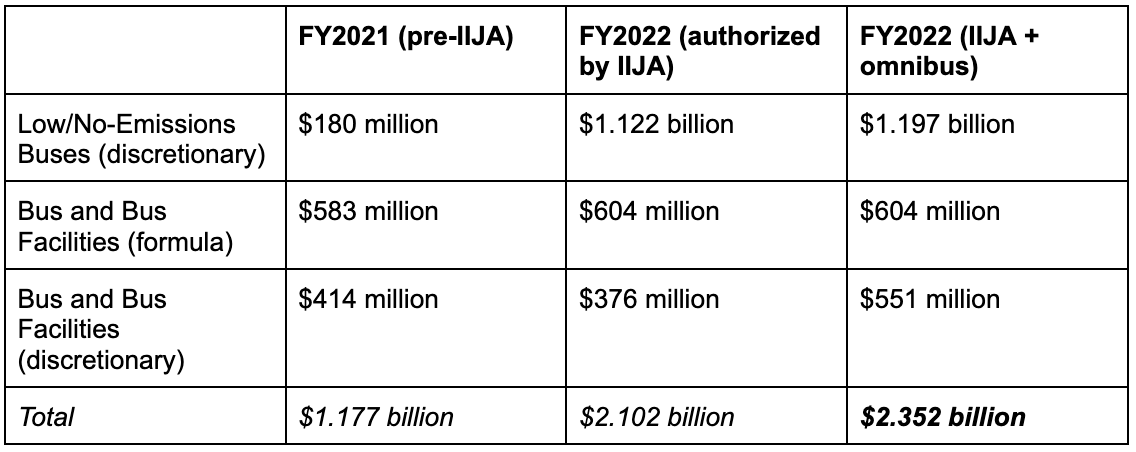
The Infrastructure Investment and Jobs Act–the “bipartisan infrastructure law” signed last year–offers limited relief when it comes to operating transit service. But the good news is that it represents a sea change when it comes to capital investment. It expands the size of the federal transit programs by at least 49%–not enough to meet all repair needs, but enough to allow many agencies to escape austerity and plan to improve the rider experience while modernizing what they have. 

A perfect illustration of this is the U.S. Department of Transportation’s most recent request for applications to the federal Bus and Bus Facilities Grant (USDOT calls this a Notice of Funding Opportunity, or NOFO). Earlier this month, USDOT issued a NOFO for two major grant programs that fund bus-related capital needs, with applications due May 31: 

  • $1.1 billion for the Low-No Emission Bus program, which pays for low-emission and zero-emission buses, facilities and equipment which supports them, and stations and stops that accommodate them.
  • $372 million for the Bus and Bus Facilities Grant program, which is used to buy, rehabilitate, or lease buses and vans and “bus-related facilities.” (Another $604 million in this program will be distributed to transit agencies through a legislative formula, without needing to apply.)

Like most federal grant programs, these require a local contribution (of 15-20% in most cases).

Under IIJA, nearly twice as much funding is available through these programs, with the increase concentrated in the “Low-No” program. Congress then added another $250 million to these programs in the fiscal year 2022 “omnibus” act, which was signed by President Biden on March 15 and keeps the government funded through September 30 (the additional money from the omnibus will likely be awarded through this NOFO as well.)

IIJA Grows Federal Programs for Bus Capital Needs

The growth in funding creates opportunities to use the “Bus and Bus Facilities” part of the pie for improvements to riders’ experience and working conditions. 

Historically, both programs have paid for the replacement of buses that are more than 12 years old, as well as antiquated maintenance facilities. For example, in 2021, when $760 million was awarded through the discretionary parts of these programs, 107 of the 119 grants were for normal bus fleet replacement or updating or replacing old facilities. 

Other types of bus improvements have long been eligible, but have always received a small slice of the program. Bus and Bus Facilities grants have helped pay for benches, shelters, and ADA improvements at 100 bus stops in Salt Lake City; bus rapid transit corridors in Albany, New York and the Bronx; bathrooms for riders and workers in Lewiston, Idaho; modernized fare collection systems at agencies in Massachusetts and Texas; and new buses associated with service expansion in Seattle

These types of upgrades are not “nice to have” – they are fundamental to providing universal access and a dignified transit experience. Installing bus shelters has been shown to increase ridership, and can correct the longstanding pattern of agencies dedicating more funding to rail facilities than bus facilities. A lack of access to restrooms is an abiding health and safety concern for transit workers across the country. And ADA accessibility determines whether or not someone can use transit at all. 

Transit agencies which have struggled to simply maintain bus fleets now have more leeway to think big. Agencies with plans on the books to improve the bus riding experience, like Houston’s METRONext or Atlanta’s Move MARTA, should look to the Bus and Bus Facilities program (and other programs expanded in IIJA) to accelerate those plans. Doing so will require the identification (and political support) of local funding sources that can meet federal matching requirements.

For agencies without such plans in the works – now is the perfect time to escape the austerity-driven replacement mindset, and to think expansively about how to compete for and use this money. And advocates, it’s up to you to provide them with ideas and encouragement. 

This information provided by

    Ashley Pryce | Senior Advocacy Associate
    Pronouns | She/Her/Hers
    1 Whitehall Street | 17th Floor
    New York, NY 10004
    apryce@transitcenter.org | c.917.374.0322


Support us and Contact Us


Wednesday, February 2, 2022

Transit Equity Demands for the SC Lowcountry, Feb. 4, 2022

Transit Equity Demands for the SC Lowcountry, Feb. 4, 2022

Our upcoming actions to push transit progress in the Lowcountry Forward are listed on our BFLT Facebook Events Page. 

Bus Stop- Mt. Pleasant, SC Town Hall
Goals for 2022

  1. Extend the existing CARTA #10 Bus Line Northwest from its current terminus at the Health South Hospital on Highway 78, up Highway 78 through Ladson and Lincolnville to Summerville. SC before May 4, 2022 using the recent 800k grant from the US Dpt. of Transpiration. See details on this proposal. 
  2. Secure another year of bus service to the beach. Double ridership. (Approve by CARTA Board at January meeting.) See detailed information  on bus service to the Beach
  3. Increase CARTA Ridership by 30%. Get more middle school aged students on transit. We've already begun work on our Park Pleasantly Play Downtown effort in Mt. Pleasant.  CARTA's board voted in April to make May a fare free month as part of rebuilding ridership with our commitment to support the effort. CARTA Ridership is now up 13% over March 2021 to March 2022.
  4. Push the future Lowcountry Rapid Transit line terminus back North to Lincolnville, near the Charleston County line, walking distance from downtown Summerville. Details on returning the line to Summerville.
  5. LCRT before I526- Fight to get the promised Lowcountry Rapid Transit line operational before work begins on widening I526. Read our blogpost Transit First, 8 Lane Gridlock Later on this issue. Read the statement by Dana Beach founder of the Coastal Conservation League on why enlarging I526 will make congestion worse. 
  6. Obtain 10 more lighted & sheltered bus stops on the CARTA system, 2 on the Sea Islands & 2 in Summerville. One great new stop on Houston Northcutt (image above) in Mt. Pleasant shows was a fully realized stop which emphasizes pedestrian safety on a busy road looks like, including a center island waiting area for pedestrians with lighting. 
Daniel Dewald has also compiled a list of problems and possible solutions for the failure to get functional transit operating in Dorchester and Berkeley Counties. Read Dewald's one page bullet list. 

Elections

We're also trying to help the needs of Lowcountry Transit Riders be heard during this year's elections b getting candidates to ride the bus and provide answers to our questions about local transit.  See our page on the Congressional election. We don't endorse candidates. 

Help Support Our Continued Push for Better Transit

Contribute to us through Act Blue (Tax Deductible)

For more information about Transit Equity Day

 See www.bfltransit.com or call William Hamilton at (843) 870-5299. 


Tuesday, April 6, 2021

Return the Rapid to Ladson, Lincolnville, Summerville and Sangaree Online Action Guide

Welcome to our online action guide which will give you updated one click links to more information and resources on how you can help return your rapid to Ladson, Lincolnville, Summerville and Sangaree. Background information on this issue.

You can download a printable PDF version of this document.

1. Call or write US Congressman James Clyburn and ask him to support a complete transit line from Summerville to Charleston as originally proposed in the 2015 I26 Alt Study as approved by the voters of Charleston County in the November 2016 referendum. Nearly the entire transit line is in Clyburn's district. Phone: (202)225-3315, Fax: (202)225-2313  Congressman Clyburn's contact information. Online form to contact the Congressman. 

2. Contact your other US members of Congress, Congresswoman Nancy Mace, Senator Tim Scott (who sits on the infrastructure committee and Sen. Lindsey Graham. 202-224-3121 

3. Contact your County and Municipal Elected Officials and make sure they understand that you hold them accountable for honoring the promises made before the 2016 referendum. No private group of government employee can or should make their decisions for them.  Charleston County Council controls the local funding for the Rapid Transit project.

4. Contact your state legislators House and Senate and ask them to support construction and operation or real rapid transit in the Lowcountry. Find your state legislators and get their contact information.  Representative Marvin Pendarvis represents most of Ladson, Lincolnville and the Eastern part of Summerville (sometimes called Brownsville, on the Berlin G. Myers side of the railroad tracks). Pendarvis is working on this issue, but welcomes your ideas and expressions of support. He can't do this alone.

5. Demand notice of future Transit related meetings held by the COG or its associated organizations, including the CARTA Board. Download the form from Best Friends of Lowcountry Transit.

6. Attend meetings of the CARTA Board and LCRT Steering Committee, in person or online. The next meeting of the LCRT Steering Committee and the first public meeting of that committee will be on April 19, 2021 at 1 pm. This is the link to sign up for the April 19 LCRT Steering Committee meeting You must sign up using the link to monitor the meeting on zoom. You can also attend in person.

There is also a virtual Summerville Station Area Workshop later that same day on Monday, April 19, 5:30 - 6:30 p.m. [Register Here!] regarding the Berlin G Myers station area

7. Ride local transit and get your kids to ride. They don't need rides everywhere, all the time. They can plan their trips with you on Google Maps Transit and use the Transit App on their phone to find out where their bus is and when it will arrive. Both CARTA and LINK are on both systems.

8. Support the Open the Ocean effort by Best Friends to make the new Shuttle to the Beach at the Isle of Palms work this summer. Help end the culture of mediocrity which is suffocating local transit effort. Make them so something right. Help get kids to the beach. Come to our events. Share information about the effort with people who might enjoy visiting the beach.

9. Fix Tri County Link. Contact local officials about reestablishing a publicly accountable board of directors for LINK.

10. Talk to your friends and neighbors about this issue. We cannot pave our way out of congestion. No community in the US has ever been able to do so. Without real rapid transit from Ridgeville to downtown Charleston we all face a future strangled by traffic congestion. You don't have to ride transit, but everyone needs it if we're going to get where we need to go.

11.Get on the Best Friends of Lowcountry Transit Email list.

Subscribe

* indicates required

Saturday, March 27, 2021

Open the Ocean for Kids

Open the Ocean for Kids, will use our new public transit link to the Isle of Palms to make days at the Beach available for some who have never seen the sea. Our inland communities, mere miles from our beaches are home to many children who have never seen the Atlantic Ocean. 

Rev. April 30, 2021

State Rep. Marvin Pendarvis is the honorary leader of the effort. He's actively involved, but until the Legislature is out of session, William Hamilton (843) 870-5299 or wjhamilton29464@gmail.com is handling organizational work. 

This effort is sponsored financially partially by the AFL-CIO and a number of local unions. You can contribute as well online on act blue at https://secure.actblue.com/donate/best-friends-of-lowcountry-transit--inc--1?fbclid=IwAR2LGKxdmMUqJKvcGZGKYPlZKfC0qfcvvk5SyqC0M1FAzs3556LTDvSSEi0

Children designing a transit system in Summerville.
While it seems inconceivable to those of us who grew up going to the beach there are many, many 12 year olds living in Ladson, Lincolnville, Summerville, Goose Creek, Sangaree and North Charleston who have never heard the surf, seen the sea or crossed the inland waterway. There are seven year old children here who have never lived in a Charleston where travel to the beach on public transit existed since it ended in 2013 when CARTA can celled the poorly operated Island Flex Route. Regular, reliable operation of the beloved IOP bus route which ran from downtown Charleston through Mt. Pleasant and Sullivan's Island to IOP ended with the CARTA shut down of 2002.

Open the Ocean for Kids will attempt to bring children from our inland Lowcountry communities to the beach at IOP for swimming and other fun starting with Reach the Beach Day, Saturday of memorial weekend. We'll be working with churches, youth groups and community pools to prepare children with swimming lessons, organize buddies and safety teams and make sure that these kids are adequately equipped for the ocean with bathing suits, towels, snacks and hydration. This is not a simple undertaking. Any activity involving children is inherently dangerous and requires careful preparation and security arrangements against both human and natural risks. The beach is a wonderful place but it can become a dangerous hazard for an inexperienced person in seconds. No single person can every be alone with a child unless they are a proven member of their immediate family selected with approval of their parents. Maintaining these standards while making sure that kids have fun and return to their communities empowered and enriches is not, ironically “a day at the beach.”  We'll be working with established partners like Pink House Neighborhood Resource Center West of the Ashely. 

The official kickoff for the effort will be Sun, May 16th. Duppy Conqueror's Bus2Beach Party in 
North Charleston, SC. and we'll continue with trips to the sea for kids on an irregular basis when the buses are coming until the Opening of the Ocean on July 17.

Pink House Neighborhood Resource Center
Trips will begin at neighborhood bus stops on Summerville, Ridgeville, N. Charleston, Downtown and West of the Ashley. Our conductors and experienced water safety professionals will help the Kids reach the beach, enjoy the ocean, have a snack and get home safely. 

While planning and development of this program has been ongoing for a month and builds on existing community efforts, we can't yet say how many children we'll be able to take to the sea. For families wanting to go, the effort is easier. We'll begin the effort Memorial weekend with guided rides to the beach from major bus stops for family groups.

We're confident that several dozen kids will make the trip at least. We need social workers, teachers and other people certified and checked to work with children who can swim and work in the hot beach environment to help with this effort. Our goal is a two adult to four kid team supervision structure. 

For the children who make it, we have a recognition in the form of a traditional Polynesian bone fish hook pendant which will show they've made it through their swimming lessons, reached the beach and returned safely from the sea on transit. 

While we're proud of this important effort, we need to prepare the public for the careful way in which sharing it with them has to be conducted. We don't want to humiliate children or their families by revealing their identities to the community at large. Expect a lot of pictures of feet, sand pails and sand castles and few, if any images of faces. We have to put a face on the struggle of our community to share the shore with it's children without showing the faces or revealing the identity of those children struggling with extreme circumstances. 

Activist Milicent Middleton
We're still working out the cost for this program, but our provisional budget allots One Thousand Dollars for the effort, plus some in kind donations of things like towels, flip flops, swimsuits and sun hats. Most of the money will go for safety swimming lessons at community pools and bus passes. The children can travel on CARTA for free, but we'll need bus fare for their parents or caretakers. We're accepting donations now through act blue or you can contact William Hamilton at wjhamilton29464@gmail.com or (843) 870-5299.

Please return to this document for updates or subscribe to our mailing list. 

Saturday, February 20, 2021

Summerville, Lincolnville, Ladson Transit Update Feb. 2021

 Summerville to the Sea on Transit- Feb. 2021

Louise Brown and the Mayor of Summerville
Sun, Feb. 21- Join us at the Black History Celebration on Hutchison Square in Summerville on Feb. 21 starting at 2 pm. Come learn about local Transit Equity Heros Mary Bowers and Esau Jenkins, make a button and join our new Dorchester Unit to make sure Transit runs all the way to the Atlantic from Flowertown. 

Image, Right, this month we honor Best Friends Staff Member Louise Brown, (shown here with the former Mayor of Summerville) who has been working for transit equity and social justice in the Lowcountry for over 50 years, starting with the Hospital Strike of 1969 when she and 11 other African American women stopped tanks in the streets of Charleston with their bodies and singing voices. She rode the train between Summerville and Charleston for decades, sometimes hopping a freight to make the trip as a girl. We call Louise the Mother of the Movement. You can view a photo gallery of her advocacy work

Thanks to the effort of our new Dorchester Unit, working with the rest of Best Friends of Lowcountry Transit, better transit is coming to Summerville, Lincolnville and Ladson. However there are challenges we must address now as the effort to undermine the long promised rapid transit service to Summerville has been abandoned with the tacit agreement of local officials.

Good News: Buses to the Beach, Electric Buses, More Shelters, Improved Service and Complete Streets

Thanks to your support, CARTA will restore weekend bus service to the Isle of Palms this summer. It will be possible to ride on LINK and CARTA all the way to the Beach on Fridays. Saturday and Sunday will require traveling to a #10 Rivers Ave. Bus Stop on Highway 78 near the Hospital since Link does not operate on the weekend. Service begins Memorial Weekend. We'll be helping Summerville access this new opportunity. Here is a preview of our plans, which are attracting national interest. 

Proterra Electric Bus made in SC
CARTA is electrifying it's bus fleet, starting with ProTerra buses made right here in South Carolina. More shelters are being constructed in Charleston county, most with solar lighting and soon, electronic bus arrival data. Full real time data on bus arrival times is now available for the region, with trip planning on Google Maps and the Transit App, as well as a dedicated app for Tri County Link. GPS data is transmitted from the buses and combined with Google's massive archive of travel and road data to give you accurate arrival times for your bus. CARTA bus service on James Island is having it's frequency doubled. View a video primer on how to plan your bus trips online with Google. 

Thanks to decisions made ten years ago in response to the SARs epidemic in Asia, our newer Transit vehicles were pandemic ready with improved air circulation systems, surfaces engineered to isolate biohazards and non touch doors. Locally produced hand sanitizer and masks (required) are available for free on board. Best Friends of Lowcountry Transit worked with a nationwide advocacy effort to get emergency federal Covid funding to pay for making buses ready for the pandemic and keeping service operating when ridership fell. Ridership is now increasing again.

Rep. Marvin Pendarvis
After two years, the SC DOT finally adopted a complete streets policy requiring road safer for pedestrians, transit riders and cyclists thanks to the effort of State Rep. Marvin Pendavis, who represents the Summerville east of the railroad tracks, Lincolnville and Ladson. Pendarvis is looking for citizens willing to sit on the new advisory board called for in the policy. Please contact Marvin Pendavis if you would like to serve. You can learn more about the new complete streets policy. 

The Challenge for Dorchester

Original plan for BRT service to Summerville
Summerville must fight for it's transit connection to Ladson, N. Charleston, Charleston and the Beach.
For 25 years very possible option was explored. Best Friends was instrumental in getting an improved weekday Tri County Link Service connecting downtown Summerville to CARTA in N. Charleston in 2019. In 2015, the half million dollar I26 Alt Study promised bus rapid transit connecting downtown Summerville to downtown Charleston in 59 minutes. Voters in Ladson and Lincolnville, and Charleston County approved a half penny sales tax in Nov. 2016 to fund 250 million dollars to build that bus rapid transit system and 350 million dollars to improve bus service.

Summerville's Leaders stood by while the Council of Government facilitated secret meetings at which it was decided to end the new transit system at the Fairgrounds in Ladson instead of making the long promised connection to Summerville and Lincolnville. While most Dorchester leaders claim to support a complete system, it's likely some worked behind the scenes to truncate the system to preserve the status quo from which they benefit. They like a Summerville where many people are immobile and time trapped in the car eats up more of everyone's life. Tired people and people who can't move are easy to ignore.

Our Logo
A major infrastructure and recovery bill is now being developed by the President and Congress. This may include the federal matching funds needed to build a real rapid transit system like what voters were promised from Summerville to Charleston and a seven day connection all the way to the sea. Our lives are too precious to be wasted sitting in traffic and hauling children and relatives around because we don't have buses that work.

To get involved for better Transit in Dorchester, Summerville, Lincolnville and Ladson contact Linda Saylor at lindasaylor1963@gmail.com or (843) 873-2436. 

Tuesday, June 30, 2020

Transit to the Atlantic, Summerville to the Sea

What We Need to Do

Millicent Middleton, Sea Island Unit Transit Advocate
The people of Summerville, Ladson and Lincolnville (hereinafter LinLadSum) have been telling us they want the rapid transit line completed for three years. It is time for the people of the North to drive the glacial and obscure planning process to completion and yank the concrete, asphalt and metal out of government to see it constructed and running from Summerville to the Sea.

The people of Ladson, Lincolnville and Summerville have the rights to demand a Bus Rapid Transit Line to Charleston which runs in its own, dedicated lanes, has comfortable stations and completes the trip in 59 minutes as promised in the I26 alt study . We must demand that now, before July 10, 2020 through their “LCRT online meeting” and our own socially distanced advocacy. We’re asking you to submit your comments at their online meeting and paste copies of what you tell them into the comments here so we can share it with other.

Transit Advocates Discover Unrest in the Land of the Cars

Pendarvis Campaign working on Rivers Ave.
State Rep. Marvin Pendarvis pushed us into the area, where we had done almost no work, to see what we could find. The results from Carol Dotterer and Louise Brown’s initial canvass were a shock. (Note: Marvin Pendarvis has not approved the content of this blog. He doesn’t control us. We don’t control him. He is happy to talk about his own views on transit and transportation issues and has introduced five bills on the subject.)

Despite the fading exurban landscape (now turning into subdivisions and apartments) and abundance of pickup trucks, people along Highway 78 were ready for transit. In Lincolnville, we met people who had moved here from New York to take care of elderly family members and become imprisoned in immobility. We found the area’s largest business incubator, not in a shiny government subsidized building downtown, but in the Ladson Flea Market. They were ready. Nobody had even talked to Lincolnville about the project which was to pass through their town, but they were ready. They reminded us their town had been founded by African Americans who sought freedom with their own, independent town and mobility through their connection to the Railroad. In downtown Summerville we found a business district struggling with parking and traffic issues full of people ready to ride.

Transit Advocates in downtown Summerville.
Carol and Louise also found failure. Streets and communities lacked sidewalks. The existing LINK bus service was unreliable and infrequent even though they had delightful drivers who simply wouldn’t do impossible things with a bus. Attendance at the Coastal Carolina Fair had plummeted over the years due to traffic problems which had now cured themselves. In nearby Sangaree, we found an aging 1980s large scale development stripped of its bus service where poverty and immobility were reducing resident’s quality of life. We attempted to leaflet the Summerville Senior Center, where they called the Police Department to run our quiet leafleting effort off their property, we saw a man walk out to the edge of their property, old and frail, visit a tree alone and then struggle back with his cane. Had their been barbed wire around the perimeter, it wouldn’t have been a more effective prison for him.

Autocentric Oppression

Carol Dotterer with BRT Survey mark
The car is mandatory in LinLadSum. It dominates the landscape, the politics, and the lives of people. Those who have one, are slaves to it, spending as much as three hours a day locked inside it. Running simple errands might take an hour. They must buy more cars for their teenaged children in hopes they can escape the unending trial of parent as chauffer between the empty communities where nothing happens and the remote soccer fields and shopping centers where time can be somewhat better spent. The empty houses surrounded by the bare spots in the grass where all these expensive, sometimes broken cars are parked are barely homes. They’re places full of people so busy and exhausted trying to go somewhere that no one is really there. It’s cruel and stupid. It has to end.

For the elderly, poor, disabled, and young who don’t have access to the automobile. Survival is a humiliating marathon of begging for rides, calling Uber and doing without. There are desperately needed affordable apartments in Lincolnville sitting empty because you cannot survive there without a car and many elderly people have outlived or live far from their families. For the carless of Ladson, trip the grocery store is a goal requiring days of planning for the starts to align. A trip for pleasure or to explore the landscape tourists travel from around the world to see is an unimaginable luxury. The precious begged for rides must be conserved for the doctor, pharmacy and store. If you can walk to the LINK route, the bus may not show up at all or simply drive past. There is no bench or shelter to wait.

LinLadSum Does Not Have to be this Way

It does not have to be this way. Ladson, Lincolnville and Summerville have public transit which would embarrass a third world country. We’ve met people who know from personal experience that it is inferior to what they have in Ethiopia. Our Latino friends in Ladson assure it Brazil is better.

BLFT staff with transit planning activity
Bad transit preserves the political power of the men (they are almost all men) who fear what unleashing the creativity, citizenship and power of people in their region might do to their eroding grip on control. Parents who can show up for meetings. Seniors who can visit each other without being protected from transit leafleting. Young people who can explore and learn about the world. Freedom remains a dangerous thing.

The voters of Charleston County have already appropriated 250 million dollars to build and operate a Bus Rapid Transit Line to Summerville in their 2016 half penny sales tax referendum. The people of Ladson and Lincolnville have been paying for it with higher sales taxes since May of 2017. In Summerville, the tiny section needed probably doesn’t require a bond referendum.

We were promised a trip from downtown Charleston to Summerville in 59 minutes. Recently the Convil of Governments has proposed a system which runs in ordinary traffic from Charleston Southern to the edge of Downtown Summerville. Politicians in Summerville have proposed a Park and Ride lot on 5th Avenue which would be five long blocks from Hutchison Square. The fact that someone might want to walk to or from the Bus Rapid Tranist system to downtown Summerville doesn’t seem to matter to them. They’re building a system for people to drive cars to parking lots to fit in the car saturated world they feel secure in.

Failure Alert

Lincolnville Town Hall
A Rapid Transit System which attempts to operate in regular traffic on the long, congested six miles of Highway 78 will fail. It won’t be rapid. It will be snarled in Traffic Congestion. It won’t be system because it won’t be able to keep a schedule any better than the exasperated drivers who can’t tell their wives, husbands and children when they might get home in their cars now. Finally, it won’t be transit because few people will ride it. Slow buses which wander around and maybe show up somewhere sooner or don’t work. In theory you can take the #1 CARTA Express to the Otranto Park and Ride and the LINK to Summerville and complete the trip (to the edge of town) in an hour and 28 minutues. In practice my best time, in several tries, has been two hours. It once took 2 hours and 45 minutes, when Ironcially, I attempted to take transit to a transit and road planning meeting at Azalea Park.

A few weeks ago, Lowcountry Up is Good, a locally based political action committee leafleted parts of Ladson in a lightening storm with the help of young volunteers organized by Linda Saylor. It was the last day before the election. When we told the kids there was no tomorrow, to just come back in. They asked if their efforts might decide the election. I told them they could. They hurled the doors of the van open and visited 250 houses in the driving rain while thunder and lighting blasted around them.

Those young people deserve a world they can grow in, explore, and prosper in. It we build a world which doesn’t do that, they’ll destroy us and build their own. The tired priorities of old men who like things as they are, slow, isolating and dysfunctional, need to get out of the way.

What LinLadSum Residents Need to Do Now

Go to their online LCRT meeting.Demand what you have paid for and been promised:

  • Help us get their attention
    Rapid transit operations in dedicated lanes on Highway 78 from River’s Ave to the edge of Downtown Summerville.
  • Safe, comfortable, lighted stops which can be reached safely from the side of the road.
  • A system which can complete the trip from Line Street in downtown Charleston to downtown Summerville in 59 minutes. 
  • Service all the way to Hutchison Square in Downtown Summerville with a stop in the business district near there.
  • Connecting Service in downtown Charleston at a safe, comfortable station on Line Street which connects to Folly Beach and the Isle of Palms.

If you want something more, don’t stop there. If you are in Ridgeville, tell them it needs to come to where you live. Linda Saylor and the lightning crew are working for you in Summerville, but they need a lot of help.

We have other blogs with more information on this project:

Proterra Electric Bus made in SC
Then take whatever you’ve told them at their online meeting and copy it into to comments to this blog post where the public can see it. The COG has already told Charleston County Council that all 1500 comments submitted through their online meeting are positive. Let’s put our demands where they can be shared and known. We’ll put hard copies of what you say here in front of your leaders and try to make them ready it. If that doesn’t work, we’ll set up banners by the roadway big enough for them to read when they’re not using their cell phone to tell their wives and husbands they’ll be stuck in traffic for another hour.

Written by 
William J. Hamilton, III
Executive Director, Best Friends of Lowcountry Transit
(843) 870-5299
wjhamilton29464@gmail.com


Friday, April 3, 2020

Opportunity in an Epidemic - Transit Funding in the Covd 19 Stimulus Bill

If you act now, we can get better transit here and complete our planned rapid transit years sooner that was previously possible.

A two trillion dollar Covid 19 bipartisan infrastructure stimulus bill is expected to be introduced in the US House or Representatives on April 20. Lowcountry Congressmen James Clyburn and Joe Cunningham are both working on it now and we’ve been in contact with their staff about transit. While the current draft of the bill wastes far too much money on sprawl inducing road construction, the bill could include the funding needed to improve public transit across the US.

Please sign and share our online petition calling for the 25 billion in transit funding for Covid 19 response already approved and the trillions of dollars in future funding be used, in part, to improve transit in the Lowcountry. https://www.gopetition.com/petitions/support-covid-19-infrastructure-recovery-act-funding-for-lowcountry-public-transit.html?fbclid=IwAR3KNfHFEYTc4HTgken8qJrRmKvxI3-SkC6hRNInKSUx2I2tpLPLTREIDfQ

We just got off a national teleconference with transit equity organizers in over 20 cities. We plan to complete preparation of materials and launch our advocacy effort on Wed. April 8.

This bill could improve the quality of life and mobilty for every American, build affordable housing and needed infrastructure to deal with sea level rise and climate change, all critical issues to the Lowcountry.
These investments should be controlled and owned by the public. However there are well organized forces trying to influence the bill that want to move the US to an ownership, equity, wealth creation model where our roads, transit systems and affordable housing are privately owned and publically subsidized without accountability or transparency to the citizens. They’ve been planning a privatized transportation system which eliminates public transit and public controlled roads with free public access  for years. You can read one such Typical call for privatization of public roads, transit and infrastructure, in Forbes Magazine- https://www.forbes.com/sites/waynecrews/2020/03/31/phase-4-coronavirus-infrastructure-spending-to-start-at-2-trillion/#421c178a7099

Please sign the petition now. We know it’s a detailed document, but elected representatives will only respect the informed and precise input of voters under emergency conditions. A meaningless make public transit better blurb will only obtain a meaningless we love public transit response. Details are the mother of ac-countably, demanded and delivered.

Please feel free to contact Best Friends of Lowcountry Transit with your ideas and input. Contact Executive director William Hamilton at (843) 870-5299 or by email at mailto:wjhamilton29464@gmail.com?subject=Public Transit in the Lowcountry