| ||||||||||||||||||
|
| ||||||||||||||||||
|
On Wed. May 15, 2024 we expect to be confronted by another large pressure group from the Fairgrounds Organization attempting to pressure the CARTA Board into giving up plans for a Lowcountry Rapid Transit Stop at the Fairgrounds. Last month a group of nearly all elderly, white men outnumbered Transit advocates 50 to 1. Politicians make decisions by counting noses.

Please join us to demonstrate and make our voices heard during the public comment period of the CARTA Board Meeting starting at 12:45 pm at the Offices of the BCD Council of Governments on Casper Padgett Way in N. Charleston, #12 CARTA Bus Route.
The Fairgrounds are now the last stop on the Northern end of the Rapid Transit line since the plan to go to Summerville was torpedoed by that Town’s good ole boy’s political gang. Ladson, the area around the Fairgrounds and Lincolnville (Charleston’s County’s historically black town) are the regions’ most affordable housing opportunities now.
With over a million open jobs in the national tourism industry, skilled hospitality workers are in high demand. Recruiters from Charlotte, Miami and Atlanta have been seen in Charleston in the past. If you are young, strong, and mentally stable with skills in hospitality, these recruiters will help you move to a city where your rent will be lower, the schools will be better, and you’ll be a short, highly reliable ride on good public transit to work. As a transit rider, I’ve seen people I’ve been on the bus with for years, shake those recruiters’ hands, leave the bus stop to go to Starbucks and never be seen again. Other people have been recruiting for the healthcare industry in other cities.
In its 350-year history, Charleston has never really cared about the quality of life of its working class. From colonization, through slavery, the suppression of the mechanics, reconstruction and segregation Charleston’s rulers have always been able to count on people with little power or choice to do the hard work from cultivating rice to cleaning the toilets of tourists. Inadequate transit, along with poor education and overpriced, inadequate housing have been the tools which maintain the money machine which is greased by racism and class privilege.
However, the 21st Century has brought greater connectivity and mobility to America’s working class. Thirty years ago, finding a possible job in Atlanta, Denver or Orlando would have required poking through the want ads of days old newspapers purchased at the Book Bag on King Street, that, and finding an apartment, and knowing how the area’s transit worked can now all be done on a smart phone in minutes. Schools can be rated, local crime statistics found, and necessities priced in seconds online from a bench at a bus stop. It is no longer hard to leave.
In the bitter, divided politics of Trump era America, the belief that everyone should pull themselves up by their bootstraps and buy a car so they can sit in traffic for hours a day may satisfy the lucky retired person, who finished paying for their fifty Thousand dollars house a decade ago. They simply won’t drive to their next meeting of the fair committee until rush hour is over. When they’re too old to drive, they’ll disappear into the carless underclass that doesn’t matter.

Charleston will not be winning its long war against the future which has seen it decline from one of the leading cities in the American colonies to a tourist’s amusement park over the last 200 years. Rice cultivation, phosphate mining and the Navy Yard are all long gone. The real estate for retirees’ industry will eventually exhaust the available high land. The ocean is rising. The expectations of tourists for something authentic and friendly won’t be supplied by skeleton staffing or robots.
For the first time in the history of the Holy City, it will be forced to value the quality of life of its working class or accepting the reality of an economy where the work does not get done.
I am aware that the Exchange Club provides charitable donations. I’ve been informed that they intend to weaponize those donations to force their will on the community by forcing area nonprofits to support them. Their role in funding child abuse prevention is given prominence.
Charity has not and will never solve the Lowcountry’s problems. The fundamental problems in our economy require major treatment and surgery, not band aids. Our private, child abuse prevention programs are often incompetent, tainted with racism and class bias and serve the needs of the people who run them. Families need jobs that pay, transit that works, safe places to live and decent schools. Without this, those families will fail. I know this from personal experience from 35 years of serving as an unpaid attorney in court appointed DSS cases. I have been in court where parents were threatened with the loss of their children because they couldn’t get to charity funded child abuse treatment appointments because we don’t have transit that works.
I have been accused by members of the Exchange Club of being a know nothing woke do-gooder that meddles in public affairs. I’m white enough to get their approval, but I do the rest wrong. I have in fact been legally blind my entire life. I have never and will never be able to drive an automobile. I have been nearly killed crossing highways on foot and on bicycle to get to places I’ve needed to go. I fish for rides. I’ve paid fortunes for cabs, limos, and ride share. I have missed innumerable events because the cost to go there was simply too high, from my Senior Prom to the Mt. Pleasant farmer’s market. I’ve spent thousands of hours sitting at bus stops since the first SCE&G bus blew by me without stopping in 1977 on Coleman Blvd because white people in Mt. Pleasant did not ride the bus back then until last weekend’s delightful trip to Container Bar on the #20. I’ve done some of that waiting on bus stop benches I built with my own hands and paid for with my own money. I understand the cruel power of the car.

I have been told to leave the Lowcountry my entire life because I can’t drive a car. I probably should have, long ago. It’s too late now. My family arrived in SC in 1695. We’ve fought the Indians, the French, The Redcoats, the Yankees, the Germans, and the Japanese. We’ve built two schools two churches and one Town. I plan to stay. fight it out here and have my ashes interred beside those of my wife Julia who died after four years of helping me in this fight. I would like my ashes to be carried to Magnolia Cemetery on the LCRT.
My decision to stay isn’t going to be too much of a disappointment to anyone. However, the young family packing up to take its energy, intelligence and capacity for hard work elsewhere will be missed. Their children and their grandchildren will be missed too. When the empty restaurant spaces and unopened hotel rooms are common enough, perhaps Charleston’s ruling class will grasp what they’ve missed.

William J. Hamilton, III, Exec. Director, Best Friends of Lowcountry Tranist, wjhamilton29464@gmail.com or (843) 870-5299
 |
| Bus Stop- Mt. Pleasant, SC Town Hall |
Contribute to us through Act Blue (Tax Deductible)

See www.bfltransit.com or call William Hamilton at (843) 870-5299.
Chris Jackson- Together We Go Forward- Transcontinental Launches in North Charleston, SC on Friday, Feb. 4
North Charleston, SC- Now that life over the road has settled down, Chris Jackson is ready to connect struggling transit advocacy efforts across the United States. He will launch the national effort on Feb. 4th. Transit Equity Day at the Rosa Parks Pay it Forward Pancake Breakfast at Mini Sue Sue’s Kitchen at 3910 Rivers Ave, N. Charleston, SC 29405, ph (843) 718-1278, on #10 Bus Line. Look for the gold pop up tent at the edge of the parking lot.
The breakfast is one of several across the SC Lowcountry and US serving pancakes made with Rosa Parks’ personal recipe. Each breakfast purchased helps a locally owned business and generates an additional pay it forward morning meal for the homeless.
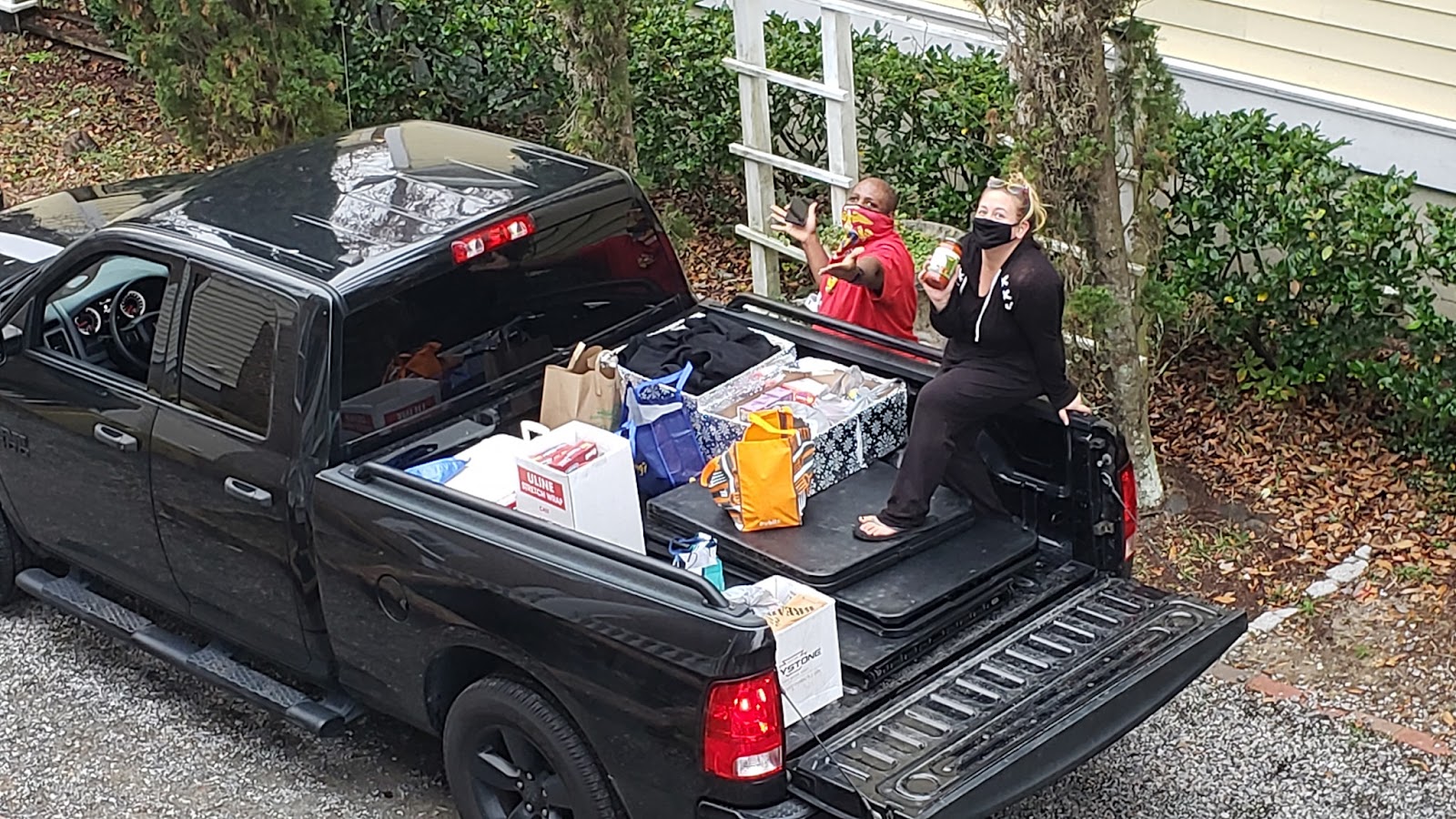
Image, above, Christopher D. Jackson (In Red) with pickup load of Christmas supplies for Charleston, SC’s homeless and Donna Gill, Dec. 2020
Transit activist and community organizer Chris Jackson earned a CDL during the pandemic and left the comforts of life in Charleston and working with Best Friends of Lowcountry Transit to mount his massive Tractor Truck and begin pulling 80 thousand pounds of cargo over the mountains and across the icy roads of a stricken nation. Chris is the supply chain. Sometimes we call him Action Jackson.

While Transit riders like regular schedules and plans, Chris isn't in a position to know when he is going to be there far in advance. His destinations change with every load, keeping the shelves of our stores stocked with what we need. When those shelves are empty, that is where he goes.
Chris will work with our national leadership to identify new and growing efforts to improve transit along the way. During his mandatory breaks and time off driving, he'll meet with transit organizers and try to help encourage new efforts. He'll collect mementos of our national effort to help people move towards better transit and drop them off in another. If you see a Bay Area Transit Rider's T-shirt on the back of a hard working bus route improvement activist in rural Alabama, you will know Chris was there. If you feed him a home cooked meal or help him do laundry, he'll appreciate the favor. If you are sleeping under a bridge, maybe he'll dip into his crock pot and give you some stew.
You can follow Christopher D. Jackson on Facebook at www.facebook.com/ElderCJacksonJackson doing street outreach in N. Chs. 2021
Chris' effort kicks off on Transit Equity Day, Feb. 4, 2022, the Birthday of Rosa Parks. Whereas Rosa Park’s feet were tired, Chris's foot is heavy. He's rolling now. Watch your texts and listen for your phone. A nation of transit advocates rises. Get ready. Together, We Go Forward!
To be put on the list of places Chris may be able to visit in the future, contact Chris @ 843 277 7958. Be sure to provide a physical address with zip code, email address and voice phone number.
 |
| Victory in the 2016 Referendum |
 |
| Lincolnville Town Hall, Mayor Duberry |

 |
| Transit Advocacy West of the Ashley |
 |
| SC State Rep. JA Moore, Transit Advocate, Chef |


 Right, Social Media Banner Promoting Rosa Pancake Effort, from 2022.